AI-Generated Background Actors: A Catalyst for Controlling the Visual Record of Reality?
by Patrick McAndrew
December 23, 2025
Life as a Background Actor
I remember the first time I worked as a background actor. I had recently graduated from college and was in that phase of trying to figure out what I was going to do with my life. I was working in college admissions at the time at my alma mater and I received a notice about a brand-new show filming its pilot episode in one of our lecture halls. How cool! While at this point, I had taken a handful of acting classes and studied theatre in undergrad, I had little experience working on a film set. I thought this could be a neat opportunity to learn what it was like, so I signed up for the opportunity. I submitted my headshot and got a call saying that they wanted me on set as one of their background actors.
That weekend, I went to my very familiar campus, and to the very familiar lecture hall, which had turned into a full-blown film set. Hundreds of crew members trapsed about along with close to a hundred background actors. Much of the day involved waiting around, sitting patiently while the crew rearranged the cameras to film scenes at different angles. I had the opportunity to sit next to one of the main actresses and learn about her career in between takes. I also had the chance to see the legendary actress, Viola Davis, at work. The background actors were needed for two, long 14-hour days, which could be seen as a short day for those in the industry, depending on what set you’re on. I walked away learning A LOT about how a film set operates. And the name of this brand-new show? It was the pilot episode for How To Get Away With Murder, which went on to win Viola Davis the Emmy Award for Outstanding Lead Actress in a Drama Series in 2015, making her the first Black woman to win in that category.
Since that experience, I’ve worked on many film sets and even worked as a background actor again. A background actor, for those that don’t know, essentially fills in the background of a film and television set to make it feel more realistic and lived in. If your favorite characters are grabbing a latte at a coffee shop, background actors may be meandering about so that the main characters aren’t oddly sitting in a coffee shop alone. If a character in a movie is in a public place, it is very likely that there are background actors in the scene as well. I was a background actor in a law class that Viola Davis’s character was teaching.
AI Entering Stage Left
With the rise of AI, many studio executives are eagerly finding areas across the industry where they can utilize this technology as a way to cut costs. AI-generated background actors are one of those areas. How do they go about this? Trained on enormous archives of human motion, from facial expression to how clothes move on the body, advanced AI tools can now conjure digital humans that feel uncannily real. After analyzing thousands of hours of footage, these systems reproduce not just movement, but reaction and emotion. Even the smallest background details can be mirrored with astonishing accuracy.
All signs are pointing in this direction for the future of entertainment. The recently announced OpenAI and Disney deal will give OpenAI access to vast amounts of data and IP for training their models. While SAG-AFTRA put protections in place to help protect actors, there are still some loopholes. According to SAG-AFTRA’s website, “If the producer wants to scan you to create a background actor digital replica, they are required to inform you at least 48 hours in advance or when you are hired, if less than 48 hours. The producer must obtain your consent if the background digital replica will be used in connection with a motion picture, unless the photography or soundtrack remains substantially scripted, performed or recorded.” When people need money to put food on the table, it’s difficult to say no. This, then, can create a perpetual loop until AI companies and their studio partners have more than enough data to train their models. As for those background actors who make their living doing such things? It’s time to pack up and ship out!
There has been a lot of pushback, however. Many A-list actors, including Simu Liu, are speaking out against the direction the industry is heading. In an article with Deadline, he stated, “In depriving the world of background actors, you’re also depriving people the opportunity to kind of pick up these skills.” Liu, like many, believe that art should remain a human endeavor. While CGI has been used for years to replicate large crowds (such as the armies in The Lord of the Rings franchise), AI technology is taking it to a whole other level.
The Tip of the Iceberg
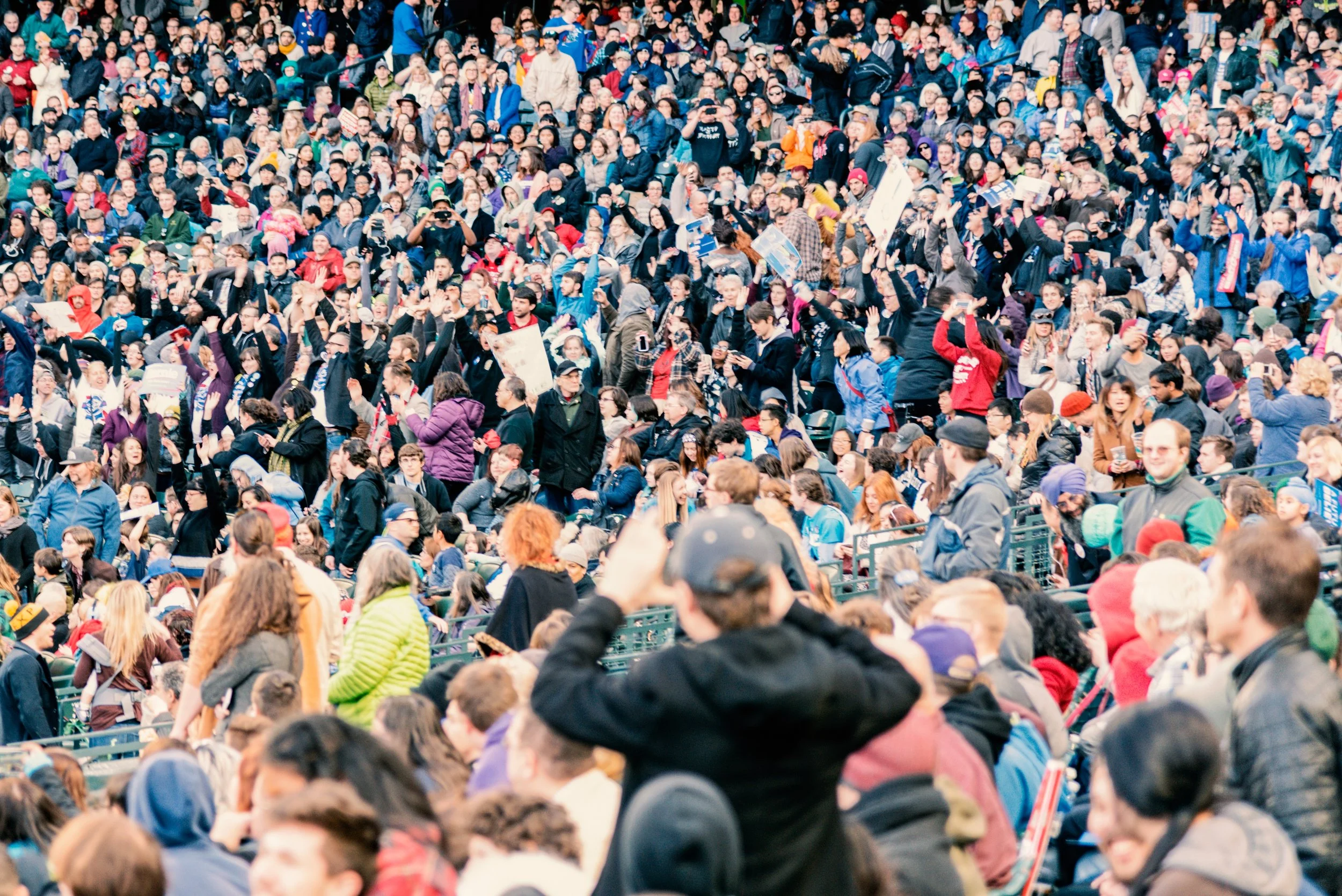
Protecting human artistry is a priority that should be on most peoples’ minds. Background actors, while seemingly insignificant, help paint a more realistic picture and aid in the storytelling. We would notice their absence in a film. But what are the larger implications of this technology? If a crowd in a movie can be completely AI-generated without the blink of an eye, who’s to say this won’t be used to alter the perception of reality? What if this technology is used to generate crowds at political or other, important worldly events? In the wrong hands, this type of use can be catastrophic to our society.
Will Smith recently posted a video of a crowd at his concert, which was discovered to be AI-generated. The latest AI generation video models, like Veo 3 and Sora 2, are getting more and more realistic. While this video itself was inconsequential, it shed a light on the fact that crowds can be powerful, and if we have the capacity to shift perception around crowd size, then there are no limits.
Charlie Fink, a lecturer from Chapman University who writes about AI for Forbes, stated, "The challenge is that most people are watching content on a small screen, and most people are not terribly critical of what they see and hear. " Fink said. "If it looks real, it is real."
The Never-ending Balance Beam
With not much AI regulation in place, it is paramount that we proceed with the utmost caution. We should assume that studios, campaigns, lobbyists, corporations, and other powerful parties are going to stretch their limits when it comes to using AI in a way that benefits them financially or otherwise. It’s for this reason that we need standards in place that will seed trust in our institutions. If we don’t establish standards, then we won’t know where to turn for any semblance of truth.
Who controls our perception of reality if it’s skewed by a deceiving technology? How can we parse out the fact from the fiction? The lines are becoming more and more blurred by the day and it’s quickly becoming apparent that it’s up to us to educate ourselves on how to avoid these deceptions.
Entertainment has always been at the forefront of new technologies. The human imagination knows no bounds, especially when we have the tools to explore it. What’s important is that we keep humans central to it all and ensure our safety beyond anything else. If we do that, then there could be a real net-benefit to how we are using AI to enhance storytelling. But if we take the human out in favor of a cheaper, more profitable AI substitute, be that as a background actor or as one in a crowd of thousands, we may begin to lose sight of our humanity in the long run and suffer as a result.
Patrick is a responsible AI strategist, writer, and actor based in New York City. He is the Founder of the Future of Entertainment Alliance, a new initiative that advocates for human creativity in entertainment as emerging technologies like AI continue to revolutionize the industry. Patrick’s work focuses on the benefits of implementing responsible AI practices with expertise in entertainment and media. He currently works on the responsible AI team at HCLTech and has worked for the Responsible AI Institute and the Entertainment Community Fund.